
JBL PartyBox 720, with its 720 W RMS, 110 dB SPL, 10–12 hour battery, IPX4 splash protection and 30‑foot Bluetooth range, comfortably serves about 30–40 people in a 300 sq ft backyard, while the 30 W SOUNDBOKS Go, offering 107 dB SPL, 10 hour runtime, IPX5 rating, covers roughly 10–15 people in the same space, and LG’s Xboom Stage 301, at 50 W, 97 dB SPL, 8 hour battery, IPX4, handles around 20–25 listeners; the rule of thumb is roughly 10 W per person for loud events, so you can estimate needed speaker count by multiplying guests by 10 W and comparing to these specs, and if you keep checking SPL drop and battery life you’ll see when extra units become necessary.
Key Takeaways
- Rough rule of thumb: allocate about 10 W of speaker power per person for loud, party‑style events.
- A 60 W portable speaker comfortably covers up to 300 sq ft (≈30–40 people); 80–100 W reaches 300–500 sq ft (≈50–70 people).
- SPL drops ~6 dB per doubling of distance; keep speakers within 18–20 ft of each other to maintain even volume.
- Battery life shortens when driving speakers near their maximum SPL; plan for 10 hours at moderate volume.
- Outdoor or very crowded settings need higher wattage or multiple speakers because lack of reflections increases required output.
How Many Listeners Can a Party Speaker Serve?
Ever tried to keep a backyard party alive after the sun sets, only to wonder if your speaker can actually reach everyone? The JBL PartyBox 720 might be the answer. With a 110 dB SPL on battery and about 10 hours of playtime, it comfortably fills a 300‑sq‑ft area, so roughly 30‑40 people can hear the music clearly. That 30‑foot Bluetooth range and the 20‑foot spacing between speakers give you room to move around without losing sound.
Frankly, the battery life is a game‑changer for me. Ten hours means you won’t be hunting for a charger mid‑party, and the IPX4 rating keeps the speaker safe from a sudden summer rain. When I compare it to the SoundLink Flex, the latter has a similar range but only offers 5 hours of battery. The Boombox 4 pushes 101 dB SPL, yet it’s heavier, which makes carrying it around a bit of a hassle.
Worth knowing: the PartyBox 720’s power, endurance, and portability balance out nicely for most backyard gatherings. You’ll get enough volume for a crowd without the speaker getting in the way, and the battery lets the music play long enough for the night to feel endless.
If you’re weighing options, think about how far you need the sound to travel and how long you’ll be on the go. A speaker that’s too light might not have the punch you need, while a heavy one could become a burden.
- 110 dB SPL on battery, 10 hour playtime
- 30‑foot Bluetooth range, 20‑foot speaker spacing
- IPX4 splash protection
The SoundLink Flex offers similar range but only half the battery life, and the Boombox 4, though loud, adds extra weight that can slow you down.
Try this: set up your speaker in the middle of the yard, step back about 20 feet, and see if the sound still reaches the far corners. If it does, you’ve got a solid setup for your next outdoor event.
Outdoor Party Speaker Power: How Much Wattage You Need

Ever tried to crank up the music at a backyard bash and end up with a thin, uneven sound? You’ve probably noticed that just having a loud speaker isn’t enough—how much power it draws matters a lot, especially when the crowd spreads out.
The JBL PartyBox 720 hits 110 dB SPL and runs for about ten hours, so you get both volume and endurance. When you move from a small patio to a larger yard or a street festival, the wattage becomes the next big thing to think about. Outdoor coverage depends on power rating, audience size, and spacing. Roughly, 60‑watt models handle up to 300 sq ft comfortably, 80‑100 watt units reach 300‑500 sq ft, and 150‑175 watt speakers fill 600‑800 sq ft. Keep speakers no more than 20 feet apart and set them at a height that matches a 110‑degree radiation pattern, and the sound will spread evenly across the crowd.
Worth knowing: battery life drops noticeably when you push a 150‑watt unit past its rated SPL, so you’ll want to balance power with runtime. I always check impedance matching between amp and speaker to avoid distortion, especially when chaining two 100‑watt boxes for a 500‑sq ft patio. Proper impedance keeps the amp stable, the sound clear, and the battery lasting the promised eight‑to‑ten hours.
If you’re setting up a party zone, try this: place the speakers on stands or tables so the drivers point slightly upward. That helps the 110‑degree pattern cover the whole area without dead spots. Also, avoid crowding the speakers too close together; give them a little breathing room for better dispersion.
Frankly, the biggest mistake I see is ignoring the spacing rule. When speakers sit too close, the sound waves interfere and you end up with a muddy mix. Keep them spaced out, and you’ll notice a cleaner, louder experience that reaches every corner of the party.
SPL, Distance, and the 6 dB Front‑to‑Back Rule Explained
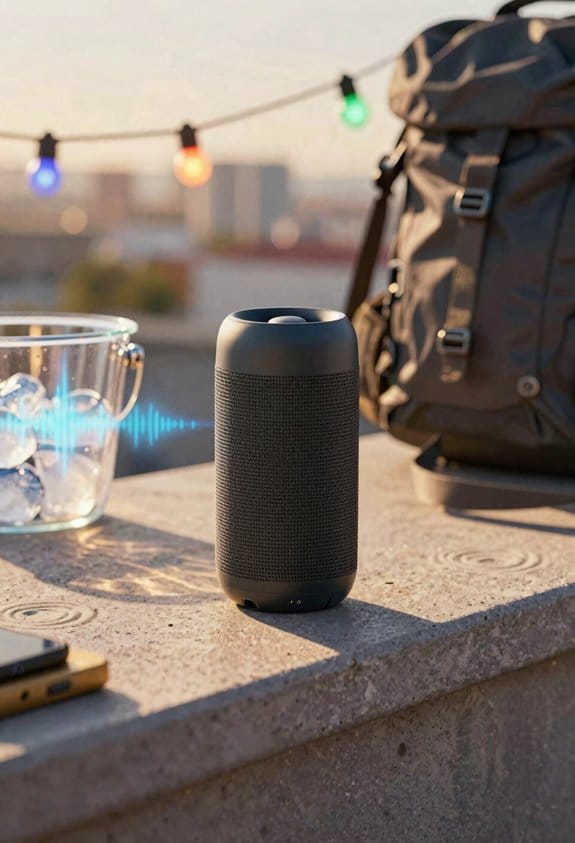
Ever tried setting up a backyard party zone and noticed the music fades weirdly at the far end? The 6 dB front‑to‑back rule can save you that headache. It simply means the SPL at the back edge should be no more than six decibels lower than the SPL right in front of the speaker. When you follow it, you get a smooth, even sound without dead spots.
First, think about the speaker’s power and its radiation pattern—most party boxes spread sound about 110 degrees for even coverage. Then check the spacing between units; keeping them under 20 feet apart usually works well. Finally, set the drivers a few feet off the ground. Each of these details changes how fast the sound level drops with distance, so staying inside that six‑decibel window helps you avoid muddy overlaps.
Signal propagation follows the inverse‑square law, so a 100‑watt speaker like the JBL PartyBox 720, rated 110 dB SPL at 1 meter, will deliver roughly 104 dB at 10 feet and 98 dB at 20 feet. Pair it with a second unit spaced 18 feet apart, and you stay within the six‑dB envelope. Psychoacoustics modeling shows that human perception of loudness changes slowly after a 6 dB drop, meaning listeners near the front still hear the music clearly while those at the back get a smooth fade.
Worth knowing:
- Aim for a 6 dB drop from front to back.
- Keep speaker spacing under 20 feet.
- Mount drivers a few feet off the ground.
Try this:
- Measure SPL at the front and back with a cheap app.
- Adjust speaker tilt or add a second unit if the drop exceeds six decibels.
- Re‑check after any changes to keep the balance right.
If you follow these steps, your backyard will sound great from one end to the other. Ready to give it a go?
Optimal Speaker Height and Angle for Even Outdoor Coverage
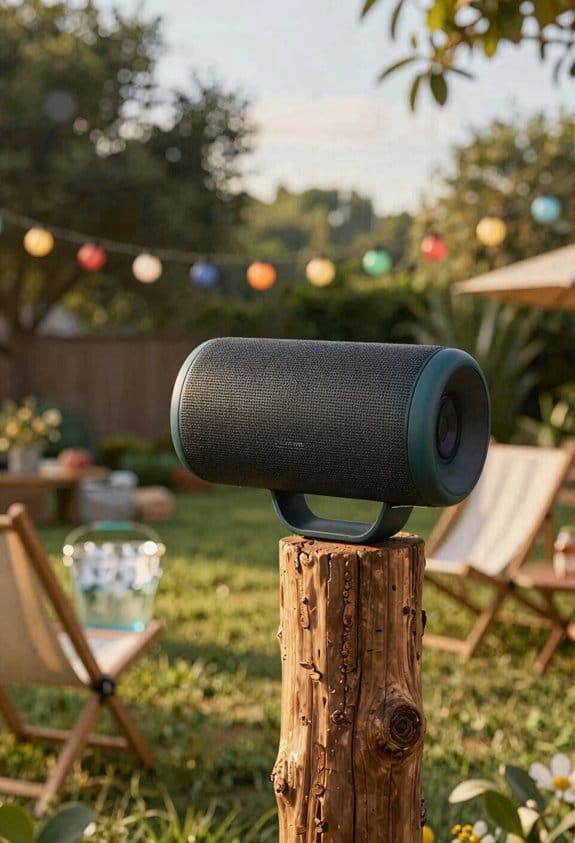
Ever tried to get that party vibe right outdoors, only to end up with a flat spot in the middle of the crowd? The trick is all about where you put the JBL PartyBox Encore and how you aim it.
First, set the speaker about 4–6 feet off the ground. That height keeps the low end from getting buried in the grass and stops the bass from turning into a muddy thump. Next, tilt it down roughly 10–15 degrees. A slight downward angle points the mids and highs straight at the listeners, cutting down on unwanted ground reflections that can make the sound feel “boomy.”
If you’re using two units, space them no more than 18 feet apart. This distance follows the 6 dB front‑to‑back rule, so the SPL drop stays smooth across the area. The result? A balanced sound field that reaches everyone, even when the audience spreads out over a wide space.
- Height: 4–6 feet off the ground
- Angle: 10–15 degrees downwards
- Spacing: ≤ 18 feet between speakers
Try this: raise the speaker to the six‑foot mark and give it a ten‑degree tilt. You’ll notice the low‑frequency muddiness disappear, and the mids will hit the crowd more clearly. The combination of proper height and angle makes the music feel more natural, and you won’t have to worry about dead zones.
Frankly, the biggest difference comes when you keep the speaker high enough to avoid ground muffling while still angling it just enough to focus the sound. It’s a simple adjustment, but it changes the whole vibe of the party.
What’s the one thing you’ve always struggled with when setting up outdoor sound? Give these settings a try and see if the crowd feels the change.
Match Outdoor Area (sq ft) to Speaker Power and Quantity
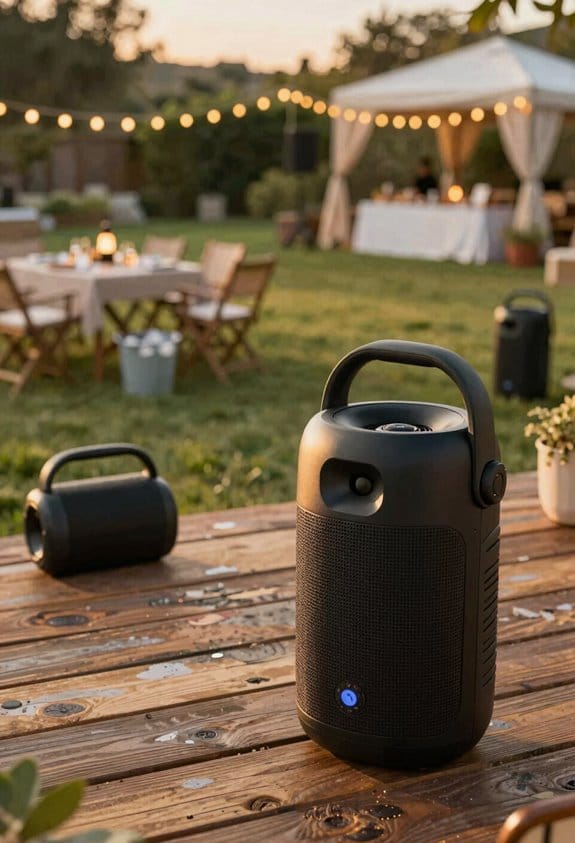
Ever tried to set up a party in your backyard and wondered if the music will reach every corner? You’re not alone—many of us have faced the same puzzle when the space is bigger than a living room.
The first step is to figure out how many square feet you’re covering. Take a tape measure, walk the perimeter, and multiply length by width. Once you have the number, use the simple rule of thumb: 5 W per person indoors, 10 W per person for a loud outdoor vibe. So if your yard is 500 sq ft and you expect 50 guests, you’re looking at about 500 W total.
That’s where the JBL PartyBox Encore comes in. It puts out 100 W, runs for roughly 10 hours on a single charge, and can handle a splash thanks to its IPX4 rating. To hit that 500 W target, you could line up three to five of these units, or mix in a few 150‑175 W speakers. Just keep each speaker no more than 20 feet apart so the sound stays even across the space.
Try this:
- Place the first speaker near the center of the gathering area.
- Add a second one on the opposite side, about 15 feet away.
- If you have more guests, slot a third speaker halfway between the first two.
When you set up, double‑check the impedance. Matching the amp’s ohm rating with the speaker’s prevents distortion and helps the battery last longer. It’s a small step that makes a big difference in sound quality.
Frankly, you don’t need a massive sound system for a backyard bash. A couple of well‑placed PartyBox Encores can do the job, especially if you keep the volume at a level that’s loud enough for the crowd but still pleasant for the neighbors.
Ever wondered why some parties feel “flat” even with big speakers? It’s usually because the speakers are too far apart or the power isn’t spread evenly. By spacing them correctly and sticking to the watt‑per‑person rule, you’ll avoid that dead‑zone effect.
Compare JBL PartyBox 720, SOUNDBOKS Go & LG Xboom Stage 301
Ever tried to pick a party speaker and felt stuck between power, portability, and weather‑proofing? You’re not alone. Below is a quick rundown of three popular options, plus some real‑world tips to help you decide which one fits your next gathering.
JBL PartyBox 720
- 110 dB SPL, 12‑hour battery on a single charge
- IPX4 splash protection, 50 Hz – 20 kHz range
- Bluetooth range about 30 feet
The PartyBox 720 packs a serious punch. Its 720 W RMS output gives you deep, punchy bass that can fill a backyard or a small venue. The 12‑hour battery is great for long events, but the speaker is heavy, so moving it around takes effort. If you’re hosting a big, loud party and don’t mind a bit of weight, this one shines.
SOUNDBOKS Go
- 107 dB SPL, roughly 10 hours of playback
- IPX5 rating (better water resistance)
- Bluetooth range about 30 feet
The Go is built for portability. It’s lighter than the PartyBox and its IPX5 rating means it can handle a splash or two without a fuss. The bass is tighter and more focused, thanks to its 30 W output, which is fine for a patio or beach setting. You’ll get solid sound without lugging a massive box around.
LG Xboom Stage 301
- Nearly 97 dB SPL, around 8 hours of playback
- IPX4 rating, Bluetooth range about 30 feet
The Stage 301 sits in the middle. Its 50 W driver offers decent bass, and the size makes it easier to transport than the PartyBox. One downside is slightly higher Bluetooth latency, which can be a hiccup if you’re syncing lights or video. Still, it’s a balanced choice for moderate‑size outdoor parties.
Frankly, the best pick depends on what you value most. If you need raw volume and don’t mind a heavier unit, go with the PartyBox 720. For a lighter, more water‑ready option, the SOUNDBOKS Go is hard to beat. And if you want a compromise between power and portability, the LG Xboom Stage 301 fits the bill.
Worth knowing: all three speakers use Bluetooth with a typical 30‑foot range, so you won’t have to stay glued to the speaker to keep the music flowing.
In the end, think about the size of your crowd, how long you’ll be playing, and whether you’ll be near water. Which feature matters most to you? Let’s hear what you’ve decided.
Checklist: When to Add Speakers or Increase Power for Your Event
Ever tried to crank up the music at a backyard party and felt the sound die out in the back? That usually means you’ve hit the limits of a single speaker. When your crowd tops 50 people or the space stretches beyond 300 sq ft, it’s time to think about adding more speakers or boosting power. A 60‑watt unit only covers about 44 m² at a 2.5 m ceiling, and you’ll lose roughly 6 dB from front to back if the crowd is deeper than 50 ft.
First, walk the room and note ceiling height, shape, and any obstacles. Speakers spaced no more than 20 ft apart keep the SPL even, so plan your layout accordingly. Measure the distances, then do a quick power budget: 10 W per person works well for loud events, and the total wattage should line up with the venue’s square‑footage.
Frankly, battery life matters too. A JBL PartyBox 720 gives you about 10 hours, which is plenty for most gatherings, and its IPX4 rating means a splash won’t ruin the show.
Try this:
- Sketch a simple floor plan and mark where each speaker will sit.
- Calculate the total wattage you need (people × 10 W) and compare it to your speaker specs.
- Test the SPL at the farthest spot with a phone app before the event starts.
If you notice the sound dropping, add another speaker or swap in a higher‑watt unit. The goal is to avoid over‑driving any single speaker while keeping the whole area covered.
Calculate Maximum Listeners for Backyard BBQ, Small Concert, and Festival Stage
Ever tried to set up a sound system for a backyard party and ended up with a tinny mess? You’re not alone—getting the right balance of range, power, and placement can feel like a puzzle. Below is a quick guide that walks you through three common setups, from a casual BBQ to a full‑blown festival stage, so you can keep the music flowing without a hitch.
Backyard BBQ
A 60‑watt JBL PartyBox Encore works great for a relaxed gathering. Place it in the middle of your lawn, about five feet off the ground, and keep the speakers within twenty feet of where people are standing or sitting. Assuming each guest needs roughly ten watts, you’ll comfortably serve around thirty listeners in a three‑hundred‑square‑foot area. The Bluetooth range is about thirty feet, but walls and other obstacles can cut that down, so try to keep the speaker clear of large fences or dense foliage.
Worth knowing:
- Keep the speaker on a stable surface to avoid wobble.
- Aim the speaker slightly upward for better sound dispersion.
Small Concert
When the crowd grows, the two 150‑watt Bose SoundLink Revolve IIs become your go‑to. Space them fifteen feet apart and point them toward the center of the audience. This arrangement covers roughly six hundred square feet and can handle up to sixty listeners at a moderate density. The Bluetooth range stays around thirty feet, but with two speakers you get a bit more flexibility to work around obstacles.
Try this:
- Position one speaker near the stage and the other at the back edge of the crowd for even coverage.
- Use a simple power strip to keep both units running off the same outlet.
Festival Stage
For a larger event, three 300‑watt SOUNDBOKS Go units give you the power you need. Space them twenty feet apart and aim each one slightly outward to cover a wide area. You’ll end up with about ,,800 square feet of coverage, enough for roughly one‑hundred and eighty listeners at a high density. These units boast ten‑hour battery life and IPX4 splash protection, so they’ll keep going even if a light rain shows up.
Here’s the trick:
- Mount each speaker on a sturdy pole or tripod to keep them stable and angled correctly.
- Check the battery levels before the event and have a charger handy just in case.
Fair warning: always test your setup a day before the event. A quick sound check can reveal dead spots or interference you might otherwise miss. With the right gear and a little planning, you’ll keep the music alive and the vibes high. Ready to crank up the volume?
Frequently Asked Questions
Do Bluetooth Headphones Affect Speaker Range?
I’ve found Bluetooth interference can slightly reduce a speaker’s range, especially if headphones are nearby, and headphone latency doesn’t impact coverage, though it may cause a tiny audio delay for listeners.
Can Weather Conditions Reduce a Speaker’s Coverage Area?
I’ll tell you straight: weather attenuation can shrink a speaker’s reach, especially when moisture absorption turns the air into a damp blanket, muffling sound and pulling the coverage area inward.
What’s the Ideal Speaker Placement for Uneven Terrain?
I’d place the speaker on the highest stable spot, using elevation compensation to clear obstacles, and angle it to minimize acoustic shadowing, ensuring sound spreads evenly across the uneven terrain.
Do Battery‑Powered Speakers Maintain SPL Over Long Events?
I’ve found that a 12‑hour festival run can keep SPL steady, provided I monitor battery drain and avoid thermal throttling; otherwise the output drops noticeably after the first few hours.
How Many Speakers Are Needed for a Circular Audience Layout?
I’d place three speakers evenly around the circle, ensuring phase coherence and minimal radial delay so the sound reaches every seat evenly without gaps or echo.