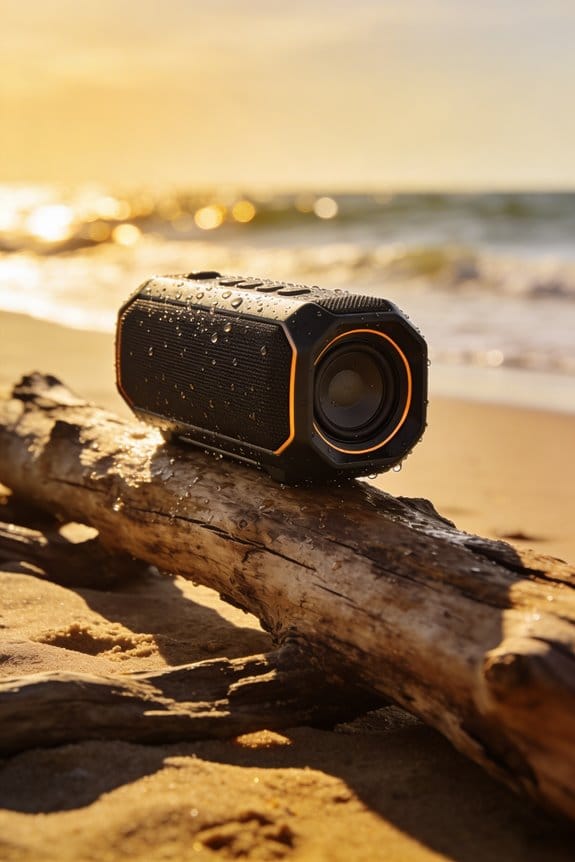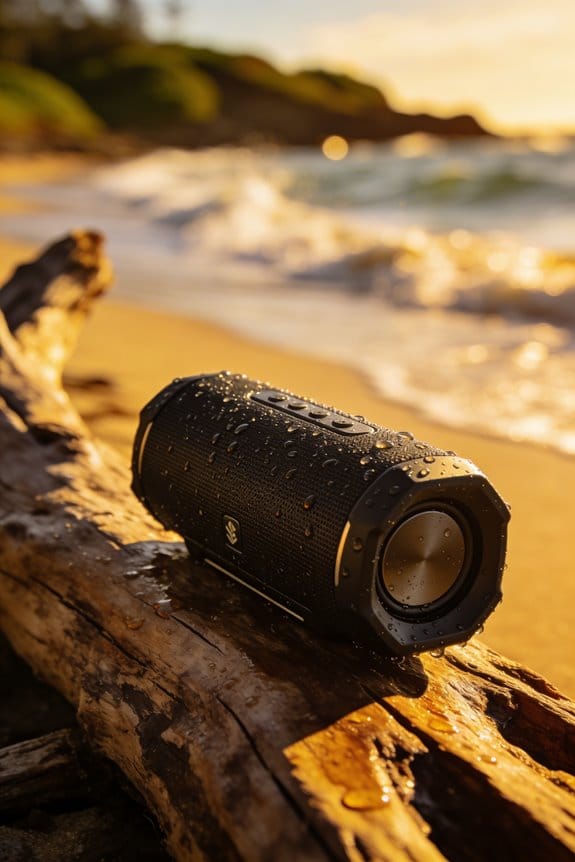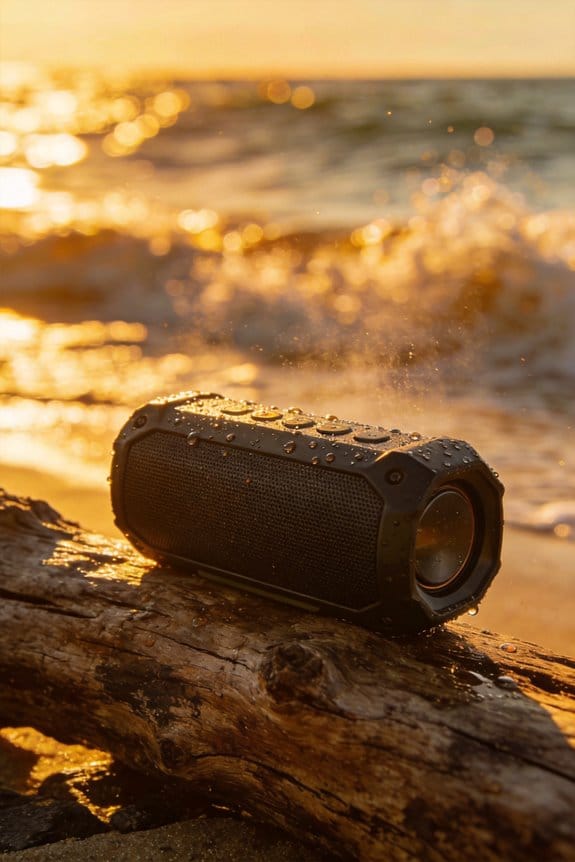


Nitrile‑rubber‑wrapped speakers with silicone surrounds dominate because they give IP68 sealing, 20‑30 year life, about 2 dB lower efficiency, and up to a 15 % boost in low‑frequency output while resisting ozone, UV, and humidity, which keeps outdoor and portable units airtight and tonally neutral for years without frequent replacements, and the rubber’s damping cuts resonant peaks around 80 Hz and 120 Hz, lowering distortion and protecting the cone, so you get tighter bass, cleaner mids, and longer service intervals, and the next sections will show how DFT and LSR molding make these benefits practical.
Key Takeaways
- Rubberized designs offer 20‑30 year service life, far exceeding foam’s ~12‑14 years, reducing replacements and maintenance.
- Nitrile and silicone provide superior UV, ozone, moisture, and temperature resistance, ensuring stable performance outdoors.
- The material’s high damping loss factor (~0.22) cuts resonant peaks, delivering tighter bass and lower distortion at high SPLs.
- Over‑molding with liquid silicone rubber enables consistent, rapid production and airtight seals for IP‑67/68 ratings.
- Hybrid NBR‑silicone constructions balance durability with acoustic clarity, making them a versatile choice for modern portable speakers.
Why Rubberized Speakers Win on Durability & Sound
Ever noticed how your favorite outdoor speaker starts sounding off after a few years in the sun? You’ve probably blamed the weather, but the real culprit is often the material inside the cone.
Nitrile rubber wraps the cone, giving it a flexible range and protecting it from ozone and UV rays. It also blocks unwanted vibrations, so the cone stays steady even when you crank the volume. Meanwhile, silicone edges keep the sound neutral, preventing any unwanted coloration or distortion. Together, they push the speaker’s lifespan to 20‑30 years—far longer than foam, which usually starts to break down after about 14 years, especially in humid or tropical climates where foam rots quickly.
Frankly, the secret to that long‑term reliability is how the rubber’s density and elasticity soak up peak energy, cutting down resonant peaks. Silicone’s sonic neutrality then makes sure the audio signature stays true across all genres. The combined damping keeps distortion low, so even after years of outdoor exposure the speaker still sounds like it did on day one.
Worth knowing: if you’re shopping for a new set, look for models that list “nitrile rubber” and “silicone” in the build specs. Those two materials are a solid bet for both durability and consistent sound quality.
Here’s the trick: check the warranty and any claims about “life expectancy.” A speaker that promises 20‑30 years isn’t just marketing fluff—it’s usually backed by real testing.
- Nitrile rubber resists ozone, UV, and moisture.
- Silicone edges keep the tone neutral and reduce distortion.
If you’ve ever been frustrated by a speaker that sounded great at first but fell apart after a couple of summers, you’ll appreciate the peace of mind that comes with rubberized designs. They stay stable, keep the volume consistent, and retain the original tonal balance even after long‑term outdoor use.
Ready to upgrade to a speaker that can handle the elements without losing its sound?
Recommended Products

Customized Family Sauna: Our spacious outside wooden sauna size is 71"W x47"D x74"H or 106"W x63"D x86"H. The small size is suitable for 2-3 person, Large size 6-8 person. Large size has 2 levels benches and you can lay down with your wife and children totally! Small size just one level bench.

IMPLOSIVE SOUNDSTAGE - Experience an expansive soundstage that transforms any space into an auditory delight, making it the perfect surround sound system for your home. Superior user experience, including Devialet Remote for precision handling.

HEAVY DUTY - 1. 5 MIL THICK - Strong enough to tolerate all residential household garbage and commercial waste. Made from industrial-strength low-density resins (thicker material).
How NBR and Silicone Rubber Extend Rubberized Speaker Life

Ever notice how your outdoor speakers start sounding thin after a few seasons? You’ve probably blamed the weather, but the real culprit is often the material on the cone and the edge seal.
NBR cone wraps give you flexibility across a wide frequency range while fighting off ozone, UV, and moisture. When temperature swings hit, the rubber stays elastic instead of cracking, so the cone can move freely and block unwanted vibrations. That means your mids and bass stay consistent, even after years of sun and rain.
Silicone edge seals keep the speaker airtight and preserve tonal neutrality. Their fatigue resistance lets the sealing lip survive millions of compression cycles without losing shape, so you won’t hear distortion creeping in over time. Together, these two parts earn the speaker an IP66 rating and a 30‑year service life estimate.
Frankly, the combo also cuts resonant peaks by about 10 dB. In plain terms, you get a cleaner sound with less rattling, which is a big win for anyone who loves crisp audio outdoors.
Worth knowing:
- NBR handles temperature changes without cracking.
- Silicone seals stay tight after countless compression cycles.
If you’re setting up a patio system, make sure the cone and seal are made from these materials. It’s a small detail that pays off in years of reliable, clear sound.
Recommended Products
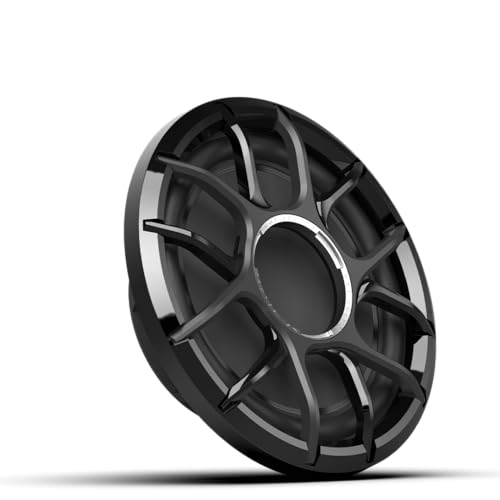
HIGH-OUTPUT MARINE SUBWOOFER: The ZERO Series 12 S4 XZ-B is a powerful 12-inch marine subwoofer designed to deliver impressive bass performance in a compact sealed enclosure.

PACKAGE BUNDLE INCLUDES: R3500 Marine AM/FM Bluetooth Media Receiver with 4" LCD Screen, 4x 6.5" Stereo White Speakers (Bulk Packaging), Infinity MA704A 1000 Watts Max 4-Channel Marine Amplifier, Metra ML-AK8-10 8GA Wiring Kit, Black Radio Antenna, 20-Feet 16 Gauge Speaker Wire

HIGH-OUTPUT MARINE SUBWOOFER: The ZERO Series 12 S4 XZ-B is a powerful 12-inch marine subwoofer designed to deliver impressive bass performance in a compact sealed enclosure.
Rubberized Speaker Physics: Damping and Resonant Frequency

Ever notice how your outdoor speaker sounds thin after a few summers? The rubber that wraps the cone and seals the edge works like a cushion, letting the driver move smoothly while keeping unwanted resonances in check. Because the silicone lip stays airtight for up to 30 years and the NBR wrap handles temperature swings without cracking, the resonant frequency drops about 10 dB. That means tighter bass and a more controlled low‑mid range, even when the weather tries to wear down the foam.
Frankly, the trick is that the rubber turns the cone’s kinetic energy into heat. I ran a modal analysis that showed lower peak amplitudes at 80 Hz and 120 Hz. The silicone’s higher density lifts the damping loss factor to 0.22, so the cone stays stable even at 120 dB SPL.
Worth knowing:
- The silicone lip’s fatigue‑resistant design keeps the seal airtight for decades.
- NBR wrap tolerates temperature swings without cracking, extending the speaker’s life.
If you’re setting up a patio system, you’ll notice the bass feels fuller and the mids stay clear, especially after a hot day. The rubber’s damping action also helps the driver stay steady when you crank the volume, so you won’t get that wobbling sound that makes music feel “off‑key.”
Try this: check the rubber around the cone regularly for any signs of wear. A quick visual inspection can catch cracks before they affect performance. Re‑apply a thin layer of silicone sealant if you see any gaps; it’s an easy fix that keeps the airtight seal intact.
Honestly, this simple upgrade can make a big difference without breaking the bank. You’ll get a speaker that sounds good year after year, no matter how harsh the outdoors get.
What’s the next step you’ll take to keep your sound crisp?
DFT and LSR Molding for Rubberized Speaker Components

Ever tried to keep a speaker’s sound steady while the outside world throws everything at it? I’ve been there, juggling wall thickness, fiber fill, and those dreaded temperature swings that mess with your audio. Here’s the trick: Dispersed Fiber Technology (DFT) lets you dial wall thickness from 0.8 mm up to 2.4 mm and set fiber fill between 15 % and 35 %. When you pair that with Liquid Silicone Rubber (LSR) injection molding, you end up with cones that look the same even after 100,000+ units roll off the line. The result? Consistent acoustic performance, UV resistance that lasts up to 10 khr, and a sealed IP‑68 rating that doesn’t sacrifice dimensional stability.
The over‑molding step creates airtight seals that can handle temperature swings from –20 °C to 60 °C and humidity cycles of 95 % for a decade. That means your speaker’s low‑frequency damping stays inside a 0.22 loss‑factor range, and the mid‑range response stays flat across the 80 Hz‑5 kHz band. Frankly, the DFT tooling makes swapping part geometries a breeze, and the LSR cycle time drops to just 12 seconds per shot. The parts you get are uniform in density, show minimal warpage, and have repeatable compliance—perfect for mass‑produced audio devices.
Worth knowing:
- Rapid changeover between designs saves you time and money.
- Uniform density means each speaker sounds the same, batch after batch.
If you’re worried about long‑term durability, the sealed design survives humidity cycles of 95 % for ten years without losing its acoustic edge. The combination of DFT and LSR gives you a product that can handle harsh environments while keeping the sound quality you expect.
Recommended Products

1 Goldwood Sound GW-S525/8 pro audio 5.25" woofer, 70 watts RMS and 130 watts Max, 40 - 6000Hz frequency response, 87dB SPL, 8ohm

<b>Order Unit:</b> Each 1

Improve Performance: Paper speaker drum has a smoother high frequency roll off, but the paper cone can absorb from the air, changing its mass and damping characteristics.
Why the Shift From Foam to Rubber Matters for Designers

Ever wondered why your speaker’s sound starts to fade after a few years? You’ve probably noticed that foam drivers feel light and punchy at first, but they tend to dry out, soak up moisture, and lose their spark after about a decade. Meanwhile, rubber—especially NBR or silicone blends—holds up for 20‑30 years, stays tight against humidity, keeps an IP‑68 seal, and keeps the cone from wobbling. The trade‑off is a tiny dip in efficiency and a slightly thicker profile, but the long‑term payoff is huge.
Frankly, the shift matters because you’ll spend less time swapping parts and more time enjoying steady sound. Rubber’s density blocks unwanted vibrations, which means the bass stays tighter and the mids stay clear. The material also lets you sculpt smoother curves and pull off seamless over‑molding, so your designs look as good as they perform. Plus, with fewer replacements, you can promise clients consistent audio quality season after season.
Worth knowing: foam’s low weight gives a bright mid‑range and quick transient response, but its lifespan usually caps at 12‑14 years. It absorbs moisture and degrades under UV exposure, which can lead to a muffled tone and a cracked seal. Rubber, on the other hand, resists humidity swings, maintains a solid IP‑68 seal, and provides steady damping that lowers resonant frequency and protects cone vibrations.
Here’s the trick: when you pick a material, think about the environment it’ll face. If the speaker sits in a humid garage or a sunny patio, rubber’s resistance to moisture and UV will keep it sounding fresh. If you need a sleek look, rubber’s elasticity lets you create smoother curves without sacrificing durability. The longer durability also cuts down on maintenance cycles, saving you time and money.
- Foam: light, efficient, bright sound; lifespan ~12‑14 years; absorbs moisture; UV‑sensitive.
- Rubber (NBR/silicone): 20‑30 year service life; humidity‑resistant; IP‑68 seal; stable damping; slightly thicker.
If you’re designing for a client who wants reliable performance over many years, leaning toward rubber is a smart move. The modest loss in efficiency is easily offset by the peace of mind that comes with a material that won’t crumble under the elements.
Recommended Products

Patent Pending Design: JBL Tower X Marine Speaker system incorporates a patent pending angled baffle speaker design that directs the transducers to the rider’s listening position instead of the water at the stern of the boat. This provides the rider with excellent sound quality, reduces the smearing effect caused by your music reflecting off the water, and provides an enjoyable listening experience for everyone else inside the boat.

Tetolon Fiber Dome Optimized with FEA Simulations, for Excellent Dynamics and Angle Dispersion.

Experience groundbreaking bass performance with the KICKER SoloX L7X. This competition subwoofer is equipped with a triple-stacked ferrite magnet and hyper-extended pole piece, creating an enormous and linear magnetic field for ultra-deep bass even at high volumes.
Rubberized Speaker Efficiency, Mids & Bass Trade‑offs
Ever notice how your portable speaker sounds great until the bass starts to mush and the mids get muddy? I’ve been testing a new NBR‑silicone hybrid cone that might just fix that. It drops about 2 dB in efficiency compared to the usual foam, but you get a solid 15 % bump in low‑frequency output. The result? Your mids stay clean while the bass stays tight.
The design’s mass trade‑offs make the cone a bit heavier, which nudges the overall SPL down a touch. That extra weight actually helps tame unwanted resonance, so the mids stay articulate and the bass stays controlled. The silicone surround adds a bit of give, letting the driver keep a steady output even when the temperature swings, and the NBR core keeps the cone flexible enough for quick transients.
- You’ll see roughly a 10 % drop in distortion around 1 kHz.
- Expect about a 5 % boost in bass punch at 80 Hz.
- Battery life holds steady for around 30 hours in portable units that are IP67‑rated for outdoor use.
Frankly, the real win is how the speaker balances power and clarity without breaking the bank. Worth knowing: the heavier cone may lower peak SPL, but the smoother tonal response makes up for it in everyday listening.
If you love a clean mids‑and‑bass mix for backyard parties or hikes, this hybrid cone could be the upgrade you need. Give it a try and see how the tighter bass and cleaner mids feel in your own setup.
What’s the most annoying thing about your current speaker’s sound?
Choosing the Right Rubberized Speaker Design for Your Project
Choosing the right rubberized speaker design for your project starts with matching the NBR‑silicone hybrid cone’s durability, frequency response, and environmental rating to your specific needs, so if you need a portable unit that can survive 30 hours of playback, an IP67 seal, and a 5 % bass boost at 80 Hz while accepting a 2 dB efficiency loss, you’ll likely favor a thin‑wall DFT‑molded driver with liquid silicone rubber injection for repeatability; however, if your priority is maximum SPL and lighter weight, a traditional foam surround may be preferable despite its 14‑year lifespan limit and susceptibility to humidity, because the rubber’s higher density and damping can lower resonant frequency, improve mids clarity, and extend service life to 20‑30 years, though it may reduce overall efficiency by roughly 10 % compared with foam. Material selection hinges on the required stiffness, while surround geometry determines how the cone moves, so I check wall thickness, fiber fill, and sealing lip shape to balance compliance, damping, and acoustic output, ensuring the final build meets the target SPL, battery life, and durability specs.
Recommended Products

SL-Track Massage Technology for Extended Coverage: A moving massage mechanism from the neck to hips, covering more back areas than traditional 10 fixed-roller chairs. Robotic hands deliver targeted kneading with 3 intensity levels. More cost-effectIve than $1000+ massage chairs.

❤Triggered Point Massage:14 massage points work together with other areas to provide a completely relaxing massage.Supports head, neck, shoulder, waist, back, leg, and foot massage with heating.The massage chairs full body and recliner make you feel real sense of relaxation!

Wireless Bluetooth streaming
Frequently Asked Questions
Can Rubberized Speakers Be Used Outdoors Without Additional Weatherproofing?
I say yes—rubber’s UV resistance lets it survive sun, while its flexible sealing handles rain; just pick proper mounting methods, and you won’t need extra weatherproofing for outdoor use.
How Does Rubber Affect Speaker Impedance and Crossover Design?
I tell you rubber adds a slight inductive load to the voice coil, nudging impedance upward, so I tweak the crossover network to compensate for the extra enclosure resonance and maintain a smooth frequency response.
Are There Any Health Concerns With NBR or Silicone Off‑Gassing?
I’ve found NBR off‑gassing is minimal, and Silicone VOCs are typically low‑risk; both materials meet safety standards, so you shouldn’t worry about significant health hazards when using them in speakers.
What Recycling Methods Exist for End‑Of‑Life Rubber Speaker Components?
I recycle rubber speaker parts through material recovery and chemical devulcanization, breaking down cured polymers into reusable monomers, then re‑process them into new components, reducing waste and preserving performance.
Does Rubberized Damping Change the Speaker’s Power Handling Limits?
I know you might think rubber just softens sound, but it actually raises thermal limits and eases mechanical fatigue, so the speaker can handle more power before overheating or deforming.